Cashmere Specials x BGNM: The String Archestra

I had the pleasure of hosting and curating this one-off radio show together with the String Archestra as part of the BGNM’s collaboration with Cashmere Radio in Berlin. You can listen again to my conversation with Daniele G. Daude and Nadja Grothe here: https://cashmereradio.com/episode/cashmere-specials-x-bgnm-the-string-archestra/

And here you can listen back to the other shows in the BGNM radio series: https://linktr.ee/bgnm_bgnm

Online Panel on Digital Musical Experiences | ZKM Karlsruhe

I enjoyed discussing the challenges and opportunities presented by digital musical experiences as part of the ... aus freier Lust … verbunden … / Einklang freier Wesen project at the ZKM in Karlsruhe. A recording of the evening’s livestream can be found here > https://www.youtube.com/watch?v=Lzu7isVosG8 (Panel from 1h 45 min onwards)

Nice to Meet You | Workshop for field notes / INM Berlin

I’ll be hosting an online workshop on developing relationships with audiences in contemporary music with saxophonist and composer Meriel Price on June 15th.

You can sign up here > https://www.field-notes.berlin/en/festivals/54722/counselling/54732/workshops/54735/nice-to-meet-you

Nice to Meet You…

The core audience for contemporary music overwhelmingly belongs to an educational elite and audience members’ experiences can vary strongly according to their knowledge of the art form. Recent audience research has emphasised the need to broaden and diversify the audience base for contemporary music, calling for greater participation and more attention to be paid to creating positive, inclusive concert-going experiences.

The central aim of this workshop is to consider how we relate to audiences in the field of contemporary music and to encourage reflection on the ways in which greater audience diversity could be reached. Do existing concert and presentation formats need to be rethought in order to speak more effectively to new audiences? In how far does the music itself need to adapt? Should the audience already be taken into account when developing an artistic idea or are informative/outreach events or alternative formats enough to stimulate curiosity and impart knowledge about the art form?

Taking demographic data and research on the interests and views of audience members as a foundation, we would like to encourage discussion on these topics and develop ways of connecting with new audiences from different social backgrounds and walks of life.

Workshop

In this workshop, we will seek to develop strategies that encourage participation from audiences and bring them into a dialogue. The first part of the day will present a practical, step-by-step guide to creating and implementing a strategy, drawing on statistics and concepts from research on contemporary music audiences and from the audience development literature. Gina Emerson will additionally present insights from her recent doctoral dissertation on the audience experience of contemporary music. Participants can either bring an existing project idea to work on or choose to develop a new idea at the workshop.

In the second half, Meriel Price will lead a creative group work session and offer ideas for new ways of reaching and connecting effectively with audiences. The workshop will overall take a general view of audience development, one that is centred around encouraging practices that consider the audience’s viewpoint and look to creatively and sustainably engage new audience members in the realm of contemporary music.

Holly Herndon’s ‘Proto’ at the Volksbühne Berlin

Following the release of her latest album Proto in May, Holly Herndon took to the Volksbühne last night with producer Mat Dryhurst and her Ensemble for the Berlin premiere of the album’s AV live show. This strongly collaborative record looks to create ‘new forms of communion’, to add a human touch to electronic music production. It combines traditional vocal music with rich electronic processing and features the first steps of Herndon’s very own musical A.I. baby, Spawn.

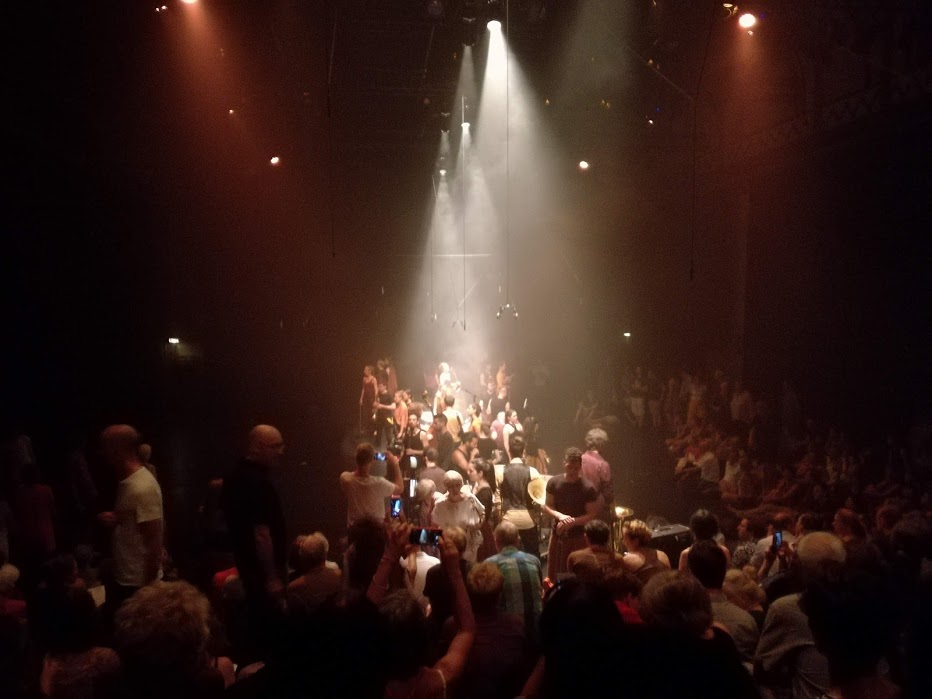
That the Proto live show was conceived with similar themes in mind was very clear. Throughout, I had the feeling of being invited to participate, rather than to watch. The performers were placed right at the back of the Volksbühne’s domed stage, allowing the audience to mill around freely on the main part of the stage. It made the cavernous space intimate and direct. For those further back in the seated area, it turned the audience members into performers, staging a show within a show.

The aim of humanising (musical) technology is not uncommon among electronic musicians, but Herndon’s commitment to this goes beyond most. The group of singers that form the ensemble around Herndon are the clearest manifestation of this. Surrounding her in a loose semi-circle, they made a palpable connection to the crowd. Sweeping performances of tracks like single ‘Eternal’, the rousing ‘Frontier’ and ’Chorus’ from Herndon’s Platform album, showed off their versatility through wailing and hocketing, displaying the kind of virtuosity that goes missing in many other live electronics performances.

While the communal feel was strong throughout, a definite highlight was Herndon’s solo vocoder performance for ‘Fear, Uncertainty, Doubt’. Perhaps the most immediate track on the album, Herndon performed it doused in a cold, white spotlight – yet it still felt warm and expressive. A couple of times I felt that Proto could have more such moments of detail among its broader strokes. Tracks such as ‘Last Gasp’ and ‘SWIM’ ran the risk of becoming a wash of sound in their live versions.

Sadly, we didn’t get to hear from Spawn on this occasion, but the Volksbühne crowd were recorded singing call-and-response patterns to be used in her training. A room of people singing folk music to create a vocal model with which to train a neural network? Definitely a new form of communion.

mde

Albums of 2018

Here’s a brief round-up of some of my favourite albums from this past year across contemporary classical music and experimental pop!

Hatis Noit: Illogical Dance
March 2018, Erased Tapes

An intriguing four-track EP from this enigmatic Japanese (and now London based) artist. The opening work, ‘Angelus Novus’, spans several soundworlds, a beguiling mix of Gregorian chant, traditional Japanese and Bulgarian vocal music and visceral electronics. Hatis Noit’s vocals seethe and soar, truly a force to be reckoned with. ‘Anagram C.I.Y’ is altogether different, taking up the vocal styles from the first track but putting the electronic production in focus to create a dizzying, choppy mix with sounds pinging all over the place (listen with headphones!). ‘Illogical Lullaby’ strips things back again, moving gently through intertwining vocal phrases. The EP also includes the Matmos remix of ‘Illogical Lullaby’, an inventive reimagination of the original.

Miolina: Miolina
February 2018, Composers Concordance

This is the debut album from violin duo, Miolina, formed by Lynn Bechtold and Mioi Takeda in 2012.  It showcases a colourful mix of compositions, ranging from the frantically virtuosic ‘Shibuya Tokyo’ by Karen Tanaka, to the drone-based musings of Jeff Myers’ ‘TAG’ and onwards to the stuttering groove of Judd Greenstein’s ‘ILL’. Particular highlights are the two works by Bechtold herself. ‘Away/Home 1.2’ muses on missing home and missing being away, fusing Japanese nature sounds with the bustle of New York and snippets of childhood music. The closing work is Bechtold’s fleeting arrangement of a lament by turn-of-the-century English composer, Samuel Coleridge-Taylor. Coleridge-Taylor’s melody floats in a hazy bubble of electronics, distant and haunting. All in all, a multifaceted, thoughtful debut.

Sudan Archives: Sink
May 2018, Stones Throw

This EP is the second release from Sudan Archives, the stage name of L.A. based singer and violinist, Brittney Parks. A little glossier than the Sudan Archives record from last year, it’s still full of her trademark violin riffs, Sudanese folk influences and sharp lyrics. ‘Pay Attention’ skids along, matching a skipping, crunchy beat to choir samples. ‘Mind Control’ is a contrast, glassy and breathy, ‘Escape’ a triumphant closer. But little matches the irresistible lilt of lead single ‘Nont for Sale’. It’s fresh, confident and full of summery swagger: ‘This is my light, don’t block the sun/This is my seat, can’t you tell?’

Tirzah: Devotion
August 2018, Domino

I’d been hoping vocalist Tirzah and producer Mica Levi (a.k.a. Micachu) would bring out a full-length album soon, after their three EPs for the Greco-Roman imprint, I’m Not Dancing (2013), No Romance (2014) and Make it Up (2015).  Devotion is another original collaboration from these two school friends. The whole album has a rusty, lo-fi sheen that complements Tirzah’s freestyled meditations on love and commitment. The opening track, ’Fine Again’, drifts around expansively, setting a dreamy pace that seeps through most of the record, such as on ‘Say When’, the hypnotic ‘Do You Know’ and ’Affection’, with its stark piano loop. The pair mix their own cloudy blend of scuffed pop, dance and soul, with glimpses of Levi’s contemporary classical background appearing every now and then, like in the angular piano riff that grounds the title track.

Third Coast Percussion: Paddle to the Sea
February 2018, Çedille

A sprawling collection of works on the theme of water, Paddle to the Sea is the latest release from the Grammy Award-winning percussion quartet. It’s centred around the group’s own composition of that name, a score for the 1966 film adaptation of the children’s book, ’Paddle-To-The-Sea’, by Holling C. Holling. While the score traces the narrative of the film, it definitely makes for a captivating listen on its own. Its nine movements are rich in timbral exploration and wind creatively through a number of recurring ideas, at times building momentum gradually (as in ‘Flow’), at times invigorating and urgent (as in the climactic ‘Niagara’). Around the other works on the disc, the beautiful arrangement of the Shona traditional ‘Chigwaya’ by Musekiwa Chingodza and Jacob Druckman’s shimmering ‘Reflections on the Nature of Water’, the ensemble have interspersed four newly arranged movements from Philip Glass’ ‘Aguas da Amazonia’. This set of pieces has had many lives – but Third Coast Percussion’s version sounds crisp and original. ‘Madeira River’ and ‘Amazon River’ in particular are breathtaking bookends to the album, the former leaning deliciously in to the curve of Glass’ yearning chord sequence each time it comes round, the latter closing out the record with an enveloping glow.

Audience Research at the Ultima Festival, Oslo

This post originally appeared on the Ulysses Network website.

I’m heading back from my final Ulysses audience research trip to the Ultima Festival in Oslo, Norway’s main annual contemporary music festival. I conducted the very last survey of the project at this installation by German composer Alexander Schubert. Since I’m aiming to explore the reception of different concert formats, I wanted to include at least one event that completely breaks with the standard concert setup. Schubert’s work Control provided ample opportunity to investigate this. Taking on themes of surveillance and manipulation, audience members were let into the installation in groups of four, wearing headsets and VR goggles. Nothing was projected onto the goggles, instead these were used to support a camera and to restrict the participants’ peripheral vision. Once inside, the participants received instructions over the headset from a controller who could view the footage from their participant’s camera. They were told to move through the space and, as far as possible, interact with the performers, who were distributed in different darkened rooms in the sprawling basement of the former Norwegian National Gallery. While the performers never spoke to the participants and also had their faces obscured with goggles, all sorts of different and strange interactions took place, from having to copy yoga-style positions in an eerily lit room to lying down in a gloomy tent with the instruction to close one’s eyes and relax (as happened to me).

In the second part, the participants became the people controlling, giving instructions to the next batch of audience members before emerging from the basement and becoming ‘observers’ – in a room upstairs, the footage from all four participants’ journeys was being relayed on live screens along with the audio from the controllers. It was also possible to buy an observer ticket and just watch the installation from this room, from which, as was probably Schubert’s intention, it would have been hard to tell who was really ‘performing’ and who just ‘participating’.

All in all, a provocative and unsettling work with multiple ways of engaging with it. I handed out the questionnaire to both participants and observers as they exited the venue. From this, I got 88 responses from the 100 audience members who attended across the two days the installation was open, 23 from observers and 65 from participants. The questionnaire had two questions that were asked in addition to the main set I’ve asked at every other survey. The first of these was aimed to investigate the immersive/interactive dimension to the piece and was differently phrased for participants and observers, asking participants whether they’d enjoyed being able to interact with the performers and being a part of the work and asking observers if they would have preferred to participate. At a first glance, the responses seem very mixed, as might be expected for a work that certainly does not shy away from pushing audience members’ comfort zones. On the whole, it looks like most observers wouldn’t have wanted to participate on the basis of what they saw of the work, though some acknowledged they may not have been able to judge this sufficiently (‘Observation does not really give you [an] impression about the piece’). A lot of participants did say that they enjoyed being active in the work (‘unpleasant in a good way’ was one comment on this), which speaks to the possible gains of a format like this one, but others seemed to have reacted negatively to this aspect of this work.

For the second extra question, I wanted to see if the participants would report their experience as being more memorable than the observers (by asking both groups to rate their agreement with the statement ‘I had a memorable experience at Control’). I’ll have to look at this properly once the data is typed up but it seems as if observers were indeed slightly less likely to call their experience memorable. The result of this question will be interesting in discussing further what audiences can get from participatory formats – do they necessarily make more of an impact?

Another aspect that came up a few times in responses was the amount of information available about the work prior to the event. The composer had specifically requested that little information about the piece be released in advance, which made for some false expectations about the work and format. One response mentions expecting that the performers would be playing instruments (I had thought this too!), but this was not the case. Another comment highlighted quite precisely the difficult balance in giving enough information about a piece vs. keeping an artwork’s mystery: ‘I am really sad I didn’t know more about the piece before I came. At the same time, it felt exciting to not know anything. Unfortunately, it felt more like a scary movie than a music piece.’

dav

#freebrahms: the STEGREIF.orchester at Radialsystem V

Berlin’s STEGREIF.orchester is a collective of 30 young classical musicians with an unusual mission. They compose new versions of classical symphonies and perform them without scores or a conductor, aiming to free them of their baggage and bring them up close to new audiences. Their recent #freebeethoven and #freeschubert projects infused Beethoven’s 4th and Schubert’s 9th symphonies with dance and improvisation, to much acclaim.

On Saturday evening, I caught a performance of their latest work, #freebrahms, a choreographed reimagining of Brahms’ Third Symphony in F major. After being freed firstly of our shoes, the audience entered the smoke-filled (and sweltering) main hall to find the group clustered in the centre of the room, meditatively humming a version of the opening harmonies of the symphony. We were invited to sit in the stands or find a place on the floor around the musicians.

What ensued was a set of 15-minute versions of each of the four movements. Brahms’ themes would swell up every now and then and immediately be used as material for improvisation in a dizzying range of styles: klezmer-tinged clarinet, jazz guitar, a wailing cello and vocal solo. The clarinet melody from the 2nd movement merged into an extended saxophone solo, a clever way of subtly ‘updating’ it. The musicians were almost constantly in motion (cellists and bassist included!), dispersing into the stands, throwing themselves on the floor for sections at a time, the percussionists wheeling around on small platforms. A theatrical cello solo ended in the player tearing and biting his bow hair and then snapping the wood in half.

I found a lot of the choreography effective and in some moments, it brought out the strange and experimental elements in Brahms’ score. For instance, the players began the third movement processing around the small central stage with clunky, zombie-robot movements, emphasising the peculiarity of Brahms’ stop-start waltz.

All of this culminated in a crazy, exhilarating fourth movement, in which Brahms’ Hungarian inflections went through the STEGREIF blender and came out as salsa, complete with conga drums and cowbell. Something happened that has most definitely not occurred at any previous performance of Brahms’ Third Symphony: people got up and danced. They danced, they clapped rhythms back, they cheered. It was infectious.

I’m definitely not a Brahms purist. I think a lot of classical music is pretty danceable and that this repertoire needs to be treated flexibly: it can and should be chopped up and reblended. It’s also helpful to remember that improvisation by performers was often a part of compositions up until roughly the late 18th century and that some composers pre-Brahms did think about how to play with the physical setup of the performance (e.g. the close of Haydn’s ‘Farewell’ Symphony, where the players are directed to leave the stage one by one).

But the right balance between enriching reinvention and watering something down is difficult to achieve. At times, STEGREIF’s imaginative performance risked diluting itself into ‘Brahms 3: The Musical’. The close of the first movement, for instance, was celebrated with a kind of ‘We Will Rock You’ bashing out of the main theme, supported exaggeratedly by electric guitar and drum kit. And while Brahms does bring back the opening harmonies at the end of the symphony, he doesn’t quite bring back the main theme like the STEGREIF arrangement did (albeit much more calmly than at the end of the first movement). Maybe less would have been more…

But hey, in many ways a symphony is just a collection of bangin’ tunes. So why not get to the point and present it like that? The STEGREIF performers played their version with such conviction, as if this is something they’d always been itching to do with this old piece of music. You can argue about whether Brahms had been appropriately liberated from tradition, but a dancing, clapping crowd of all ages testifies to one thing: it certainly felt freeing to experience STEGREIF’s performance. And maybe that’s the more important result.


IMG_20180728_200930